Invisible captivity
Doctor ZhivagoInvisible captivity names the contradiction at the center of Yurii Andreievich’s life with the partisans: he is neither behind walls nor under watch, yet is not free to leave. His dependence is enforced through circumstances and repeated capture rather than visible restraints, and the promise that liberty will come later only prolongs the present confinement. The idea extends beyond his particular detention to forms of compulsion that appear so ordinary or intangible that they can be mistaken for freedom itself.
The form of the captivity
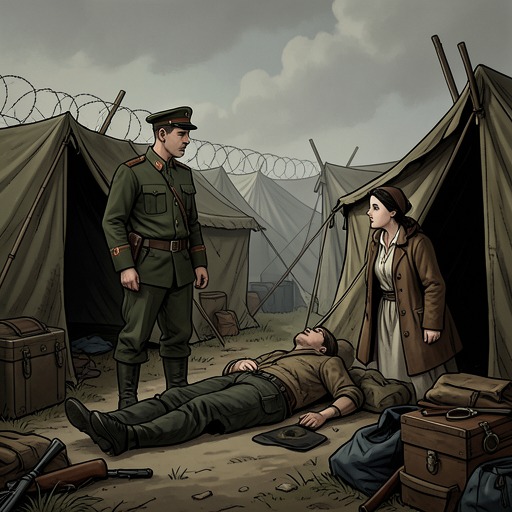
More than a year after the partisans took Yurii Andreievich prisoner, the boundaries of his freedom remain undefined. The force is constantly on the move, and he moves with it. It does not stay apart from the local population, but mingles with the settlements and lands through which it passes. There is no enclosing wall to mark where captivity begins, and no guard visibly assigned to monitor the doctor’s movements.
That apparent openness is precisely what makes the condition difficult to recognize. To an observer, Yurii Andreievich might seem free and simply unwilling to take advantage of it. Yet his freedom exists only in appearance: he has to submit to a dependence that is not made tangible by chains or surveillance. The episode distinguishes the absence of physical barriers from the ability to choose one’s course.
Escape and enforced dependence
Yurii Andreievich tests the limits of this apparent liberty three times. Each attempt to escape ends in his capture. He is not punished afterward, but the repeated failure demonstrates that the lack of visible restraint does not give him a viable route out. He stops trying, not because the captivity has ended, but because his experience has shown the danger of another attempt.
His position is further complicated by the attention of the partisan leader, Liberius Mikulitsyn, who favors the doctor, enjoys his company, and has him sleep in his tent. The arrangement may resemble protection or trust from the outside, but Yurii Andreievich finds this enforced companionship irksome. The chief’s personal preference does not alter the fact of dependence; it gives the confinement a close, interpersonal form as well as a political one.
The promise of later freedom
When Yurii Andreievich demands that Liberius let him go so he can search for his family, he makes the stakes of the captivity explicit. He does not know where his family is or whether they are alive. He also insists that, if Liberius will not release him, he should at least stop speaking and leave him alone. The request is practical and immediate: the doctor wants the ability to find those from whom he has been separated, not another explanation of the partisan cause.
Liberius answers the demand with a future promise. He justifies the detention by predicting final victory over the Whites in the spring, followed by peace, liberty, and prosperity, and says that the doctor will then be free to go. Until then, Yurii Andreievich must be patient. The reasoning turns freedom into a reward indefinitely deferred until the war’s end, while the doctor’s present choice is dismissed as something to be managed for his own good. Liberius argues that, after all the sacrifices already made, waiting a few more months matters little, and asks where the doctor could go in any case.
Captivity’s personal cost
Yurii Andreievich lies down with his face against the pillow and tries not to listen to Liberius’s renewed assurances. The scene places his physical withdrawal against the continuing argument that he should accept confinement. Inwardly, he resents the repetition and fears that his anger may become dangerous; the narrative presents that anger as a response to being denied both release and relief from the chief’s talk.
His thoughts return to Tonia and her expected child. He worries that the baby should already have been born and wonders how she managed the confinement and whether they have a son or a daughter. He also thinks of Lara, whose name he is afraid to speak. These concerns make the cost of captivity concrete: it leaves him separated from his family at a time when he does not know their whereabouts or circumstances, and it prevents him from going to find them.
Beyond visible restraints
The episode’s central distinction is between seeming free and being able to act freely. Yurii Andreievich can move with the partisans, is not kept behind a wall, and is not watched at every moment, but his three failed escapes and the demand that he wait expose the limits beneath that surface. Captivity is sustained by circumstances, power, and the expectation of compliance rather than by a single visible barrier.
The promised future of peace and liberty sharpens the irony: the partisans invoke freedom while withholding it from the doctor in the present. The idea reaches beyond one prisoner’s experience, since the narrative compares his invisible dependence with other forms of compulsion that may likewise be mistaken for figments of the imagination. Yurii Andreievich’s situation gives that abstraction a human measure: freedom is not merely the absence of chains, but the ability to leave, seek one’s family, and choose what to do next.